How Much is a 2 Carat Diamond? (2026 Price Guide)
2 Carat diamond prices have shifted fast. Compare natural ($15k+) vs lab-grown ($1.5k) costs in 2026 with live retailer pricing.

Founder of TheCaratCut. Director and software engineer with experience leading software for UFC, Al Jazeera, AMCN, The Economist, and The NHS. Director at Wayfinity, founder of Seat and Stone, and runs The Developer Safe Place mentorship community. Not a GIA-certified gemologist — articles draw on grading reports, retailer data, and personal research, and may be assisted by AI tools for drafting with human review before publication.
Last reviewed and updated 3 May 2026 by The Carat Cut editorial team. Live retailer pricing is sampled monthly via our Diamond Price Tracker.
Key takeaways
- •Natural 2 carat diamonds (G colour, VS2 clarity, Excellent cut) typically run $15,000–$26,000 in 2026.
- •Lab-grown 2 carat stones at the same spec cost $1,400–$2,200 — roughly 90% less.
- •A 2 carat round measures ~8.1 mm. It sits in the top ~10% of engagement-ring stone sizes.
- •Buying a 1.90–1.99 ct stone instead of a 2.00 ct can save 10–15% with no visible size difference.
A 2 carat diamond is the threshold where price curves bend sharply upward in the natural market — and where lab-grown stones offer the biggest absolute savings. This guide covers what you should expect to pay across shapes and grades in 2026, the magic-weight trick that saves four-figure sums, and how to sanity-check retailer pricing against live market data.
How much does a 2 carat diamond cost?
Below are typical 2026 advertised list prices for round-brilliant cut 2.00 ct stones. Setting cost is excluded.
| Colour & Clarity (Excellent cut) | Lab-grown (typical) | Natural (typical) |
|---|---|---|
| D / VVS1 | $2,400 – $3,000 | $38,000 – $50,000 |
| F / VS1 | $1,800 – $2,400 | $22,000 – $30,000 |
| G / VS2 | $1,400 – $1,800 | $15,000 – $20,000 |
| I / SI1 | $1,000 – $1,300 | $10,000 – $14,000 |
Source: monthly survey of advertised list prices on Brilliant Earth, Blue Nile, Brilliant Earth, Clean Origin and Rare Carat. Round brilliant, GIA / IGI certified, Excellent cut.
Live sampled prices
The 2.00 ct F/VS1 oval lab basket below is the closest live comparable in our tracker. The 1.0 ct G/VS1 lab basket gives you a per-retailer baseline you can scale.
Live 2 carat retailer comparison
Oval lab 2.00 ct F VS1 + round lab 1.00 ct G VS1 baseline. Pricing sampled monthly across major retailers.
| Retailer | Price | Notes |
|---|---|---|
| Rare CaratLowest | $1,850 | Marketplace median for 2.00ct F VS1 oval. |
| Blue Nile | $2,200 | Lowest in-spec stone at sample time. |
| Clean Origin | $2,300 | Lowest in-spec stone at sample time. |
| James Allen | $2,400 | Lowest in-spec stone at sample time. |
| Brilliant Earth | $3,400 | Brand premium vs. marketplace. |
| Retailer | Price | Notes |
|---|---|---|
| Rare CaratLowest | $880 | Marketplace median observed at sample time (range $815–$945). |
| Blue Nile | $1,100 | Lowest in-spec stone at sample time. |
| Clean Origin | $1,150 | Lowest in-spec stone at sample time. |
| James Allen | $1,250 | Lowest in-spec stone at sample time. |
| Vrai | $1,650 | Single-source CVD premium; no third-party undercut. |
| Brilliant Earth | $1,800 | Brand premium vs. marketplace. |
Shape changes the price by 15–40%
Round brilliants command the highest per-carat price because they waste the most rough during cutting. Fancy shapes preserve more weight and price accordingly.
| Shape | Visual face-up | Saving vs round |
|---|---|---|
| Round Brilliant | Standard | Baseline |
| Oval | Looks ~15% larger | ~20% lower |
| Cushion | Soft, antique | ~25% lower |
| Emerald | Hall-of-mirrors, smaller face | ~30% lower |
| Pear | Elongated, flattering | ~25% lower |
| Princess | Square brilliant | ~35% lower |
The magic weight trick: buy 1.90–1.99 ct
Diamonds priced "by carat tier" jump in price at psychological round numbers (1.00, 1.50, 2.00, 3.00). A 1.95 ct stone is visually identical to a 2.00 ct — a difference of ~0.1 mm in diameter, undetectable by eye — but typically prices 10–15% lower.
For a natural G/VS2 round, that's a ~$1,800 saving. For a lab-grown equivalent, ~$200. On larger stones the absolute saving grows further.
Filter retailer search tools for 1.90–1.99 ct specifically and compare against 2.00–2.05 ct results.
Lab-grown vs natural at 2 carats
The price gap is at its widest at the 2-carat mark because natural-stone scarcity premiums compound while lab-grown production costs have continued to fall. A premium G/VS2 lab-grown 2 ct stone now costs roughly 8–10% of the natural equivalent.
For broader market context see our Lab Diamond Price Shopper's Guide.
Online vs local jeweller markup
Brick-and-mortar jewellers carry roughly 50–100% markup over online retailers on a 2 carat stone. The difference is rent, sales staff, and the cost of physically holding inventory of stones that may not sell for months.
Online retailers like Brilliant Earth and Blue Nile operate on virtual inventory: stones are sourced from cutters and shipped on order. Their margins sit closer to 15–25%.
Where to buy a 2 carat diamond
Brilliant Earth
Industry-leading high-resolution imagery and showroom appointments at detailed zoom. Essential for inspecting a stone of this size before committing.
Blue Nile
Largest natural-diamond inventory online with a Price Match Guarantee. Best for non-round shapes and natural-only sourcing depth.
Whiteflash
For natural-only buyers prioritising cut precision, Whiteflash's A CUT ABOVE inventory is the gold standard for super-ideal proportions.
Visit WhiteflashA CUT ABOVE super-ideal inventoryVisit →Frequently asked questions
How big does a 2 carat diamond look on the hand?
A 2 carat round brilliant measures ~8.1 mm in diameter — roughly 50% of a size 6 finger's width and double the face-up area of a 1 carat stone. It reads as substantial without crossing into ostentatious.
Is a 2 carat diamond too big for everyday wear?
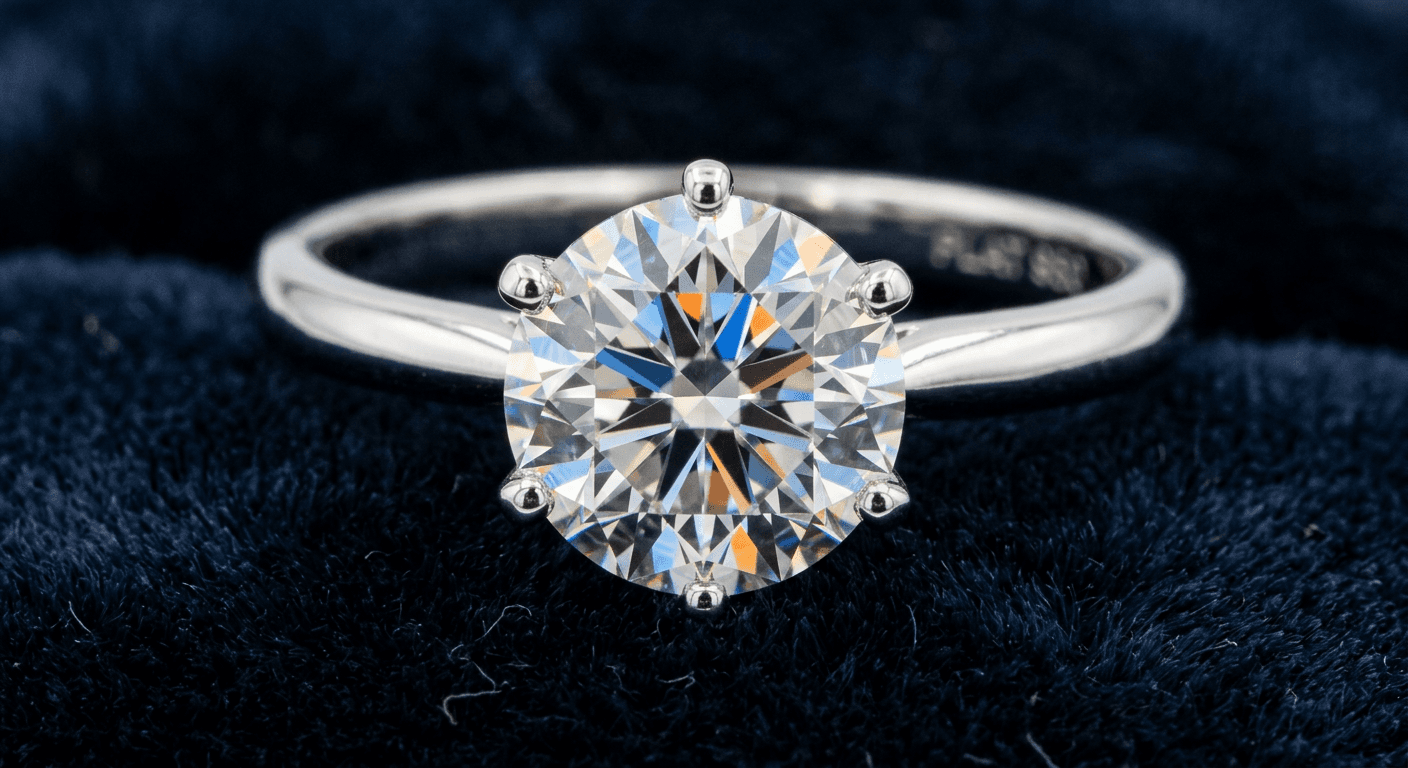
No. Plenty of buyers wear 2 carat stones daily. The bigger consideration is setting protection: choose a 6-prong or bezel setting and avoid high-profile cathedral mounts that snag.
Can a jeweller tell a lab from a natural 2 carat diamond?
Not by eye, loupe, or standard thermal tester. Lab-grown diamonds are chemically identical. Distinguishing them requires specialised growth-pattern detection equipment found only in grading labs.
What's the best colour grade for a 2 carat diamond?
H colour for white-metal settings (visually colourless without the D–F premium). I or J is safe in yellow or rose gold settings.
How much should I spend on the setting?
Plan on 8–15% of the stone cost for a quality platinum or 18k gold setting. Don't pair a $20,000 natural stone with a sub-$1,000 setting — the metal will look thin and dull next to the diamond.
Always verify a GIA or IGI certificate before purchase. Our diamond certification guide explains what each lab report means and which grades to trust. At 2 carats and above, never buy uncertified — minor grading discrepancies translate to thousands of dollars in value.
If you are comparing 2 carat options across retailers, our Blue Nile vs James Allen engagement ring comparison shows how pricing, video inspection, and return policies stack up.
More diamond pricing guides
Diamond Price Per Carat — Complete Hub
The full pricing hub spanning every popular carat weight, with shape, colour and clarity breakdowns.
2 Carat Diamond Price
Loose 2 ct stone pricing: roughly $8k-$60k natural, $700-$4,500 lab grown.
1.5 Carat Diamond Price Guide
Sweet-spot size between 1 and 2 carat — typical pricing, magic-weight tips and retailer comparison.
2.5 Carat Diamond Price Guide
Statement-piece sizing. Where to compromise on grades and how to verify retailer pricing.
3 Carat Diamond Price Guide
Major-statement carat weight. Per-carat pricing scales geometrically — see live retailer data.
4 Carat Diamond Price Guide
Every flaw is magnified. Cut, clarity and colour rules for stones at this size.
5 Carat Diamond Price Guide
The luxury tier. Investment-grade naturals vs lab-grown alternatives at sub-$10k.
Live Diamond Price Tracker
Monthly-sampled retailer pricing across major lab and natural diamond specs.
Written and edited by David Adams, founder of TheCaratCut. Our recommendations follow our editorial policy. We may earn commissions through affiliate links — see our disclosure.