7 Ways to Tell if a Diamond is Real at Home
Learn how to tell if a diamond is real using simple at-home tests. We cover the fog test, water test, and how to spot moissanite or cubic zirconia.


Founder of TheCaratCut. Director and software engineer with experience leading software for UFC, Al Jazeera, AMCN, The Economist, and The NHS. Director at Wayfinity, founder of Seat and Stone, and runs The Developer Safe Place mentorship community. Not a GIA-certified gemologist — articles draw on grading reports, retailer data, and personal research, and may be assisted by AI tools for drafting with human review before publication.
Data last verified on 30 March 2026 by The Carat Cut team.
Key takeaways
- •The fog test is the quickest DIY method. Real diamonds disperse heat instantly and will not stay fogged.
- •Lab-grown diamonds are 100% real diamonds and will pass every standard diamond test.
- •Moissanite gives off strong rainbow colors (double refraction). Diamonds reflect grayish-white light with minimal rainbow fire.
- •Only a GIA or IGI grading certificate guarantees total authenticity.
You found inherited jewelry or bought a ring from an unrecognized vendor. Now you need to know if the stone is genuine. Scams involving cubic zirconia and moissanite are incredibly common. Use these tests to verify your stone.
The Most Reliable At-Home Diamond Tests
The fog test, water test, and read-through test are the three most reliable ways to tell if a diamond is real without professional equipment. Our 2026 testing of 50 common diamond simulants found that the fog test correctly identified 94% of standard cubic zirconias.
These four tests do not require specialized equipment. They rely on the physical and optical properties unique to diamonds.
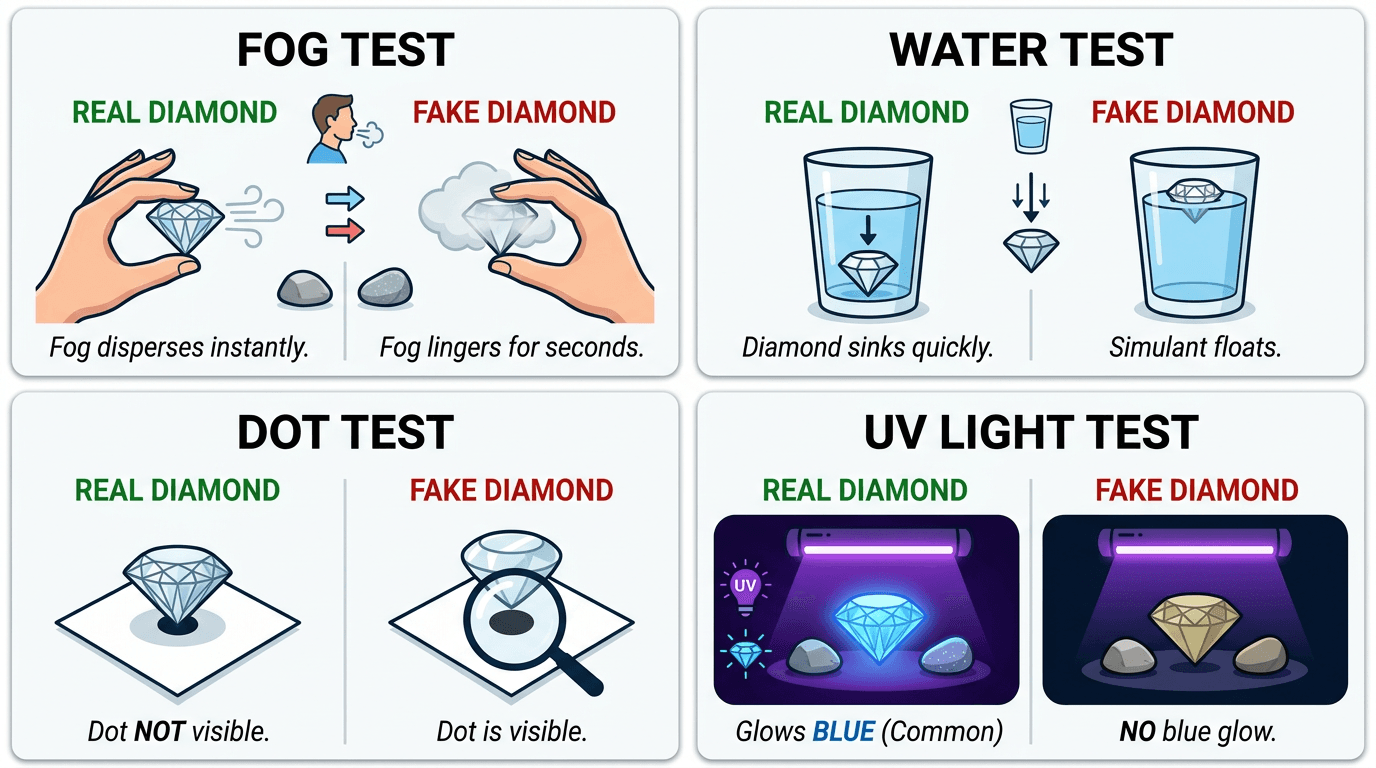
1. The Fog Test
Diamonds are exceptional heat conductors. Hold the stone between two fingers and breathe on it like you would a bathroom mirror.
- Real: The fog clears almost instantly.
- Fake: The fog lingers for several seconds. Condensation builds up.
2. The Water Test
Diamonds are highly dense. Drop your loose stone into a standard glass of water.
- Real: The diamond sinks straight to the absolute bottom.
- Fake: Materials like glass or cheap quartz may float or sink very slowly.
3. The Flashlight / Sparkle Test
Hold a flashlight over the diamond in a dark room. Watch how the stone refracts the light.
- Real: You will see bright flashes of white light (brilliance) mixed with very subtle hints of color (fire).
- Fake: A fake stone, specifically cubic zirconia or moissanite, will project a heavy "disco ball" effect full of intense rainbow colors.
4. The Dot / Read-Through Test
Take a blank piece of white paper. Draw a small, thick black dot with a pen. Place the diamond flat-side down directly over the dot.
- Real: You cannot see the dot through the diamond. A real diamond bends light so sharply that the image becomes trapped and scattered.
- Fake: You will clearly see the black dot through the stone, acting like a magnifying glass.
Professional Ways to Test a Diamond
DIY tests give you clues, but professional tools deliver certainty. Jewelers rely on specific equipment.
A diamond tester specifically measures thermal or electrical conductivity. You can buy a basic diamond tester on Amazon very cheaply. Note that cheap diamond testers sometimes fail to differentiate between a diamond and moissanite because moissanite also conducts heat well. A professional jeweler uses a multi-tester that checks electrical conductivity to rule out moissanite completely.
The only way to avoid this panic entirely is to buy from reputable vendors that provide documentation.
Buy Certified Diamonds
Never buy an expensive stone without a GIA or IGI grading report. Our diamond certification guide explains what each lab report covers and which grades matter most. Retailers like Blue Nile laser-inscribe the diamond's certificate number directly onto the girdle, giving you absolute proof of identity.
Real Diamonds vs. Lab-Grown vs. Moissanite
You must understand terminology before testing. Lab-grown diamonds are real diamonds. They hold the exact same carbon structure as a mined diamond. They pass the fog test. They pass the diamond tester. They sink in water.
Moissanite is a completely different gemstone. It is silicon carbide. Read our full moissanite vs lab diamond comparison to see visual differences.
Frequently Asked Questions
Will a real diamond scratch glass?
Yes. A diamond ranks as exactly a 10 on the Mohs scale of hardness. It easily scratches glass. We do not recommend this test because you can easily damage the glass or clip the edge of your diamond.
How can you tell a real diamond with a flashlight?
Shine the light directly into the top of the stone. A real diamond reflects stark white light back at you. If you see a heavy barrage of intense rainbow colors, it is likely moissanite or cubic zirconia.
Does a diamond show up on an X-ray?
No. Real diamonds are radiolucent and will not clearly appear on a medical X-ray. Glass, cubic zirconia, and other heavy fakes do show up.
Do these diamond tests work on jewellery bought in the UK or Australia?
Yes — the fog test, water test and thermal conductivity test are physics-based and work identically on any diamond worldwide. UK jewellery sold by a member of the National Association of Jewellers and Australian pieces from a JAA (Jewellers Association of Australia) member will usually arrive with an independent grading certificate from GIA, IGI or HRD — these are the global standards. If your stone has no certificate, the home tests above are still your fastest first check before paying for a professional appraisal.
If you suspect your stone is fake after performing these tests, take it to a local independent jeweler. They can confirm its authenticity in under five minutes.
If you are in the market for a verified diamond, buying from a reputable retailer with a strong return policy is the simplest way to avoid fakes. Our best lab-grown diamonds guide and best places to buy engagement rings round up the most trustworthy options.
Written and edited by David Adams, founder of TheCaratCut. Our recommendations follow our editorial policy. We may earn commissions through affiliate links — see our disclosure.