Lab-Grown Diamonds in 2026: An Analyst’s Guide to Pricing & Value
In 2016, a 1-carat lab diamond cost $4,000. Today, it costs $400. An analyst explains why the market crashed and what it means for your engagement ring.

Founder of TheCaratCut. Director and software engineer with experience leading software for UFC, Al Jazeera, AMCN, The Economist, and The NHS. Director at Wayfinity, founder of Seat and Stone, and runs The Developer Safe Place mentorship community. Not a GIA-certified gemologist — articles draw on grading reports, retailer data, and personal research, and may be assisted by AI tools for drafting with human review before publication.
Key takeaways
- •Lab prices have crashed 90% since 2016 due to manufacturing efficiency.
- •Chemically identical to natural diamonds, but financially opposite (Depreciating Asset).
- •Best for maximizing size (3-4 carats) on a budget.
- •Avoid for 'Investment' or 'Heirloom' purposes (Resale value is near $0).
- •Watch out for 'Brown Tint' in CVD stones and 'Blue Nuance' in HPHT stones.
In 2016, a 1-carat lab-grown diamond cost roughly $4,000. Today, that same stone costs roughly $400. This 90% collapse in price is not a "sale." It is a fundamental shift in the global diamond market.
Lab-Grown Data & Guides
If you are shopping for an engagement ring in 2026, you are facing a split reality. Natural diamonds remain a scarce commodity with retained value. Lab-grown diamonds have become a technology product—better, cheaper, and faster to produce every year.
Most guides will tell you they are "exactly the same." Physically, that is true. Financially, they are opposites. This guide ignores the marketing fluff and looks at the numbers.
The Core Difference: Chemistry vs. Economics
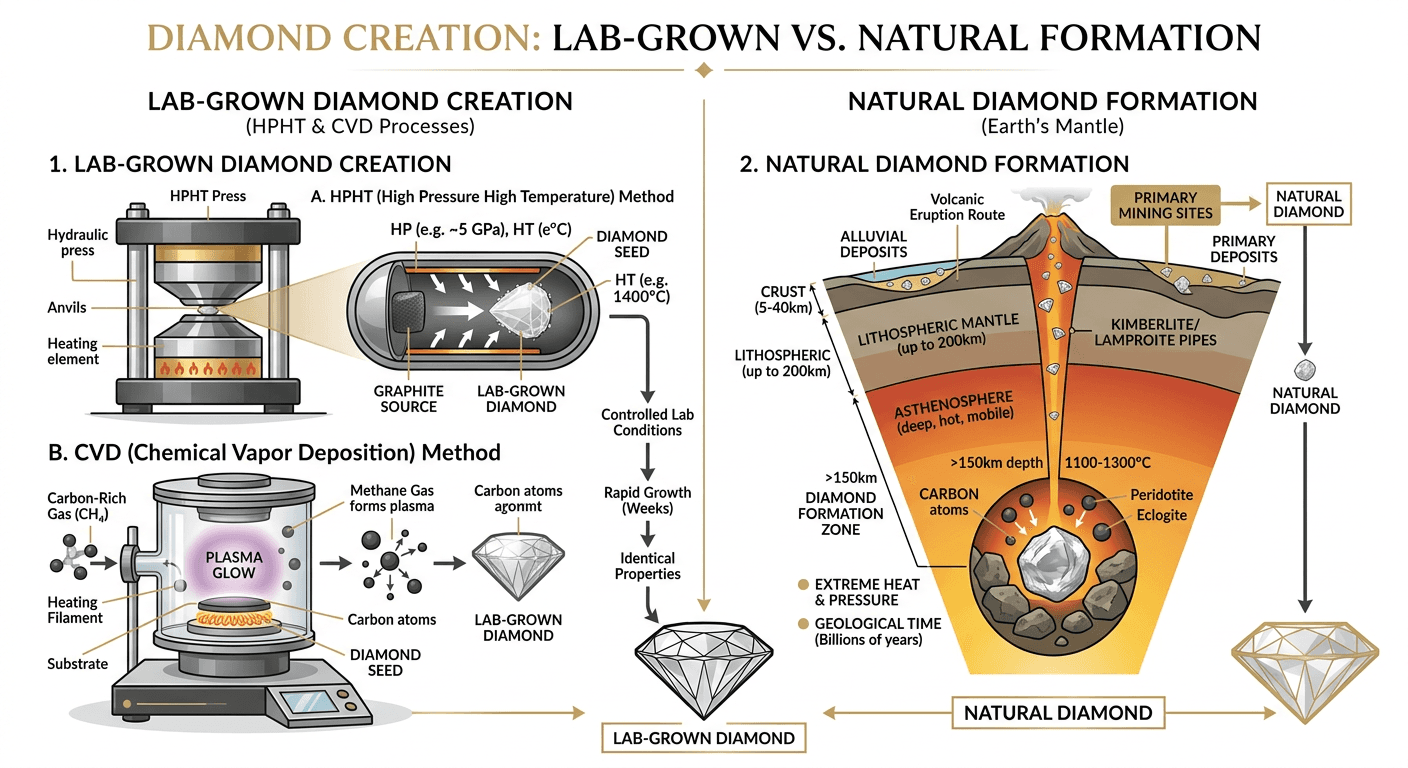
Let's start with the physics. A lab-grown diamond is 100% crystallized carbon. It has the same refractive index, hardness (10 on Mohs scale), and dispersion as a mined diamond. Even a trained gemologist with a 10x loupe cannot tell them apart. They require advanced spectral analysis machines to distinguish.
The difference is not molecular; it is economic.
- Natural Diamonds: Like waterfront real estate. There is a finite amount. New supply is difficult and expensive to extract.
- Lab Diamonds: Like flat-screen TVs. We get better at making them every year. Supply is theoretically infinite.
Think of the "Ice Analogy." Glacier ice comes from nature and is limited. Freezer ice comes from a machine and is unlimited. Once they are in your drink, they are both just frozen water. But you wouldn't pay a premium for freezer ice as an investment.
The 2026 Price Crash: What Happened?
The reason for the price crash is simple: Efficiency.
China and India have scaled up production facilities (using HPHT and CVD methods) to massive industrial levels. The cost to grow a carat of diamond has plummeted. In 2020, retailers were keeping margins high. By 2026, competition forced those prices down to the cost of production.
The Financial Verdict
Do not buy a lab diamond as an investment. Buy it as a consumption item. Treat it like buying a wedding dress, a luxury vacation, or a nice suit. You buy it to enjoy it, knowing it will have effectively zero resale value in the future.
Buying Guide: When to Choose Lab-Grown
👍 Pros
- ✓Unbeatable Value: Get a 3-4 carat stone for under $2,000.
- ✓Ethical Supply Chain: Zero mining, zero conflict zones.
- ✓Perfection: Easier to find Flawless/VVS clarity grades.
- ✓Same Look: Indistinguishable from natural to the naked eye.
👎 Cons
- ✗Zero Resale Value: You loose 100% of the purchase price the moment you buy.
- ✗Lack of Romance: Some buyers struggle with the 'mass produced' origin.
- ✗Tint Issues: Cheap lab stones often have brown or blue chemical tints.
Scenario A: The Smart Buy
You want a massive look. You dream of a 3 or 4-carat Oval cut. In the natural world, this would cost $40,000+. In the lab world, this is $2,500. You don't care about selling the ring later; you care about wearing it now.
Scenario B: The Smart Avoid
You care deeply about "heirloom status" or "store of value." You want to pass this ring down for generations as a rare asset. In this case, the scarcity of a natural diamond is what you are actually paying for.
Common Defects: The "Brown/Blue" Tint Issue
Just because they are made in a lab doesn't mean they are perfect. In the race to the bottom on price, many growers rush the process. This creates specific crystal defects that you never see in high-quality natural stones.
1. Brown Tint (CVD Diamonds)
Chemical Vapor Deposition (CVD) diamonds are grown using hydrocarbon gas mixtures. If the vacuum chamber isn't perfectly clean or the growth is rushed, the diamond can trap nitrogen or voids, giving the stone a slight brown or gray "fuzz." It looks like a dirty window.
2. Blue Nuance (HPHT Diamonds)
High Pressure High Temperature (HPHT) diamonds are grown using metal catalysts. Sometimes, excess Boron is trapped in the lattice. This makes the diamond look slightly blue or grey-blue in sunlight. While some people like this, it is technically a defect for a "colorless" stone.
Actionable Advice: This is why you must inspect the high-resolution imagery. If a stone is graded "G" color but looks brownish in the video, skip it. Stick to retailers like Blue Nile or Blue Nile that provide high-resolution imaging for every single stone.
Comparison: What $5,000 Buys You
To really visualize the trade-off, let's look at what a $5,000 budget gets you in the 2026 market.
| Feature | Natural Diamond | Lab-Grown Diamond |
|---|---|---|
| Carat Weight | 0.90 ct | 3.50 ct (Huge) |
| Color | H (Near Colorless) | E (Colorless) |
| Clarity | SI1 (Eye Clean) | VVS1 (Microscope Clean) |
| Cut Quality | Excellent | Ideal / Super Ideal |
| Asset Value | Retains ~50% | Retains ~0% |
The choice is clear. If you choose Natural, you are compromising heavily on size and quality to retain value. If you choose Lab, you get "Perfection" specifically because you are giving up the value retention.
Conclusion: The "No-Regret" Decision Matrix
The lab-grown revolution has democratized luxury. It has made large, flawless diamonds accessible to almost everyone.
If the thought of your diamond being worth $0 in five years bothers you, do not buy a lab diamond. Stick to natural.
But if you view your ring as a symbol of love rather than a financial instrument, the value proposition is undeniable. You can get the "Celebrity Look" for a fraction of the cost. Just ensure you buy from a reputable vendor that screens for material defects, and enjoy the spare $10,000 you saved for your honeymoon or house deposit.
Ready to look? We recommend starting your search here:
Written and edited by David Adams, founder of TheCaratCut. Our recommendations follow our editorial policy. We may earn commissions through affiliate links — see our disclosure.