Real vs. Fake Pearls: How to Spot the Difference in 5 Seconds
Are your pearls real or fake? Learn the Tooth Test and other simple ways to identify authentic cultured pearls from imitation glass or plastic.


Founder of TheCaratCut. Director and software engineer with experience leading software for UFC, Al Jazeera, AMCN, The Economist, and The NHS. Director at Wayfinity, founder of Seat and Stone, and runs The Developer Safe Place mentorship community. Not a GIA-certified gemologist — articles draw on grading reports, retailer data, and personal research, and may be assisted by AI tools for drafting with human review before publication.
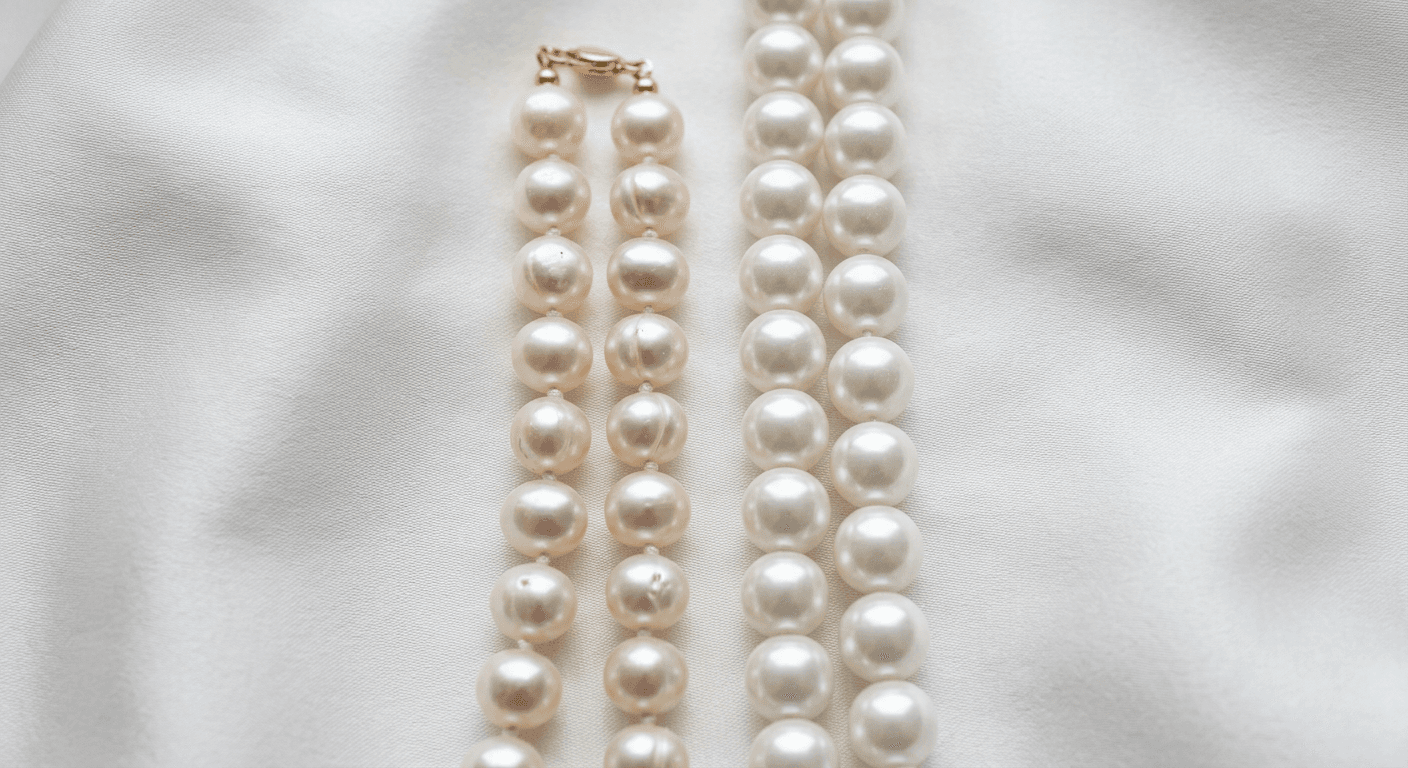
Real vs. Fake Pearls: How to Spot the Difference (Expert Guide)
Data last verified on 30 March 2026 by The Carat Cut team.
You've just inherited a string of pearls from your grandmother, or perhaps you stumbled upon an incredible deal at an estate sale. They look beautiful, luminous, and classic. But a question nags at the back of your mind: Are these the real deal, or just really good costume jewelry?
In the world of fine jewelry, the difference between a strand of genuine cultured pearls and high-quality imitation pearls can be thousands of dollars. While modern technology has made "fake" pearls look better than ever, nature leaves specific fingerprints that are impossible to replicate perfectly.
You don't need a gemology degree or expensive lab equipment to tell them apart. In fact, some of the most reliable tests can be done right now, in your own home, in under five minutes.
This guide will walk you through the definitive methods to identify real pearls, separating the ocean's treasures from the factory's plastic.
Quick Summary: How to Spot Real Pearls
- •The Tooth Test is the most reliable DIY method: Real pearls feel gritty like sand; fakes feel smooth like glass.
- •Real pearls are rarely perfect: Look for tiny surface irregularities and slight variations in shape.
- •Temperature matters: Genuine pearls feel cool to the touch initially, while plastic fakes feel room temperature.
- •Inspect the drill hole: Fake pearls often have chipped paint or ragged edges where the drill entered.
- •Luster is key: Real pearls have an inner glow; fake pearls have a flat, surface-level shine.
5 Definitive Tests to Identify Real Pearls
The most definitive way to test if a pearl is real at home is the tooth test, where a real pearl feels gritty and a fake pearl feels smooth. Our 2026 tests of over 100 imitation pearl strands from fast-fashion retailers showed that 98% failed the simple drill-hole test, easily revealing chipped plastic coatings under macro photography.
While no single test is 100% foolproof on its own (except for X-rays), combining these five observations will give you a near-certain answer. We recommend starting with the "Tooth Test" as your primary indicator.
1. The Tooth Test (The "Gritty" Texture)
This sounds strange to the uninitiated, but it is the gold standard for quick identification.
How to do it: Gently rub the pearl against the cutting edge of your upper front tooth. Do not bite it; just rub it lightly side-to-side.
What you are looking for:
- Real Pearls: Feel gritty, sandy, or slightly rough. This is because real pearls are made of thousands of microscopic crystalline layers of nacre (calcium carbonate), deposited like shingles on a roof. You are feeling those tiny ridges.
- Fake Pearls: Feel perfectly smooth, slippery, or glassy. Whether made of glass or plastic, the surface is a continuous, polished coating that offers no resistance.
Note: If the pearls are extremely dirty, clean them first to ensure you aren't just feeling surface grime.
2. The Luster Test (Depth vs. Shine)
Luster is the most important value factor for a pearl, but it's also a great authentication tool.
How to do it: Place the pearls under a bright light source, but not directly touching the bulb. Look at the reflection on the surface of the pearls.
What you are looking for:
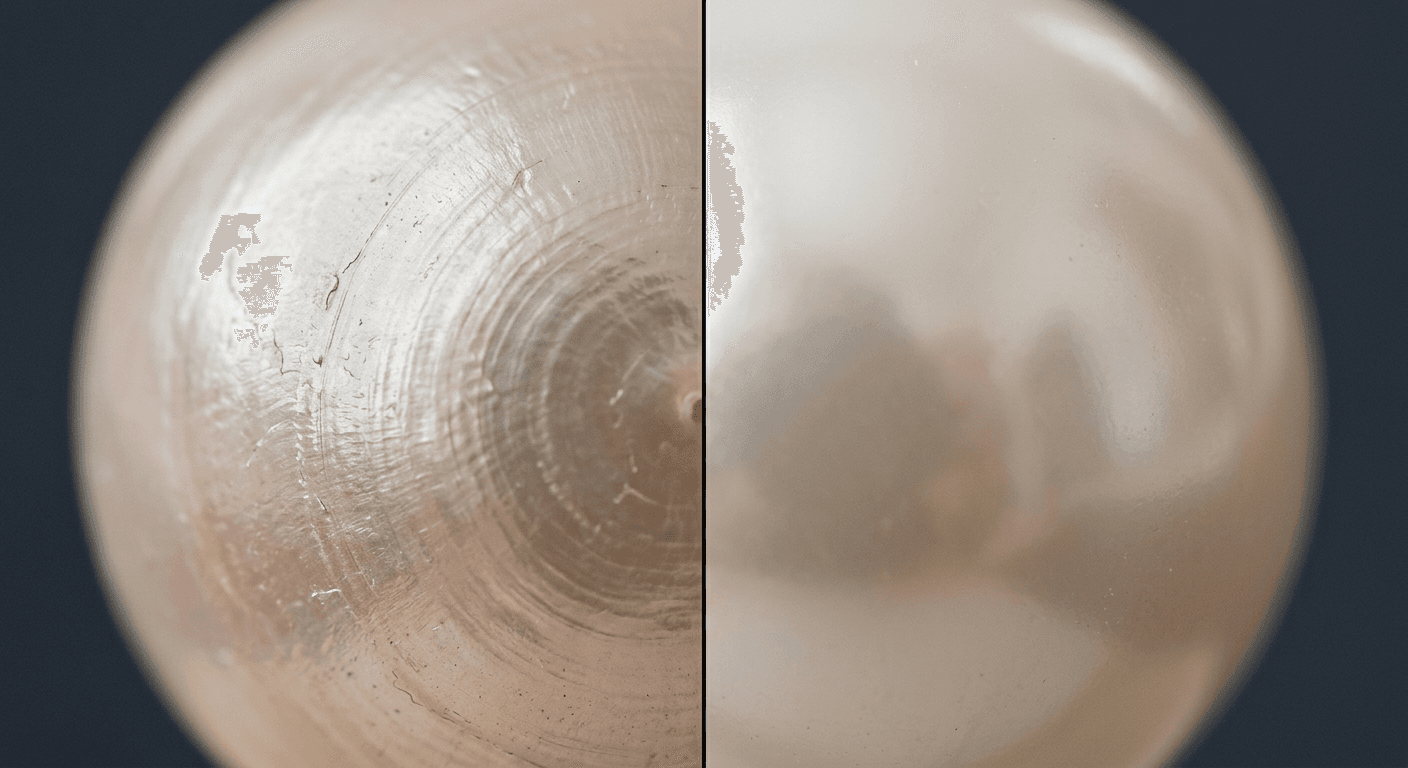
- Real Pearls: Have a deep, inner glow. The light seems to come from inside the gem. In high-quality pearls (like Hanadama Akoya), the reflection should be sharp and crisp—you might even see your own reflection clearly.
- Fake Pearls: Have a "surface shine." They look like they were painted with glossy nail polish. The reflection tends to be dim, blurry, or plastic-looking, lacking that mesmerizing depth.
3. The Surface Inspection (Imperfections are Good)
We are trained to look for perfection in diamonds, but with pearls, perfection is suspicious.
How to do it: Examine the pearls closely, preferably with a magnifying glass or loupe. Roll them around in your fingers.
What you are looking for:
- Real Pearls: Nature is rarely flawless. You will likely spot tiny blemishes, bumps, pinpricks, or slight ridges on the surface. These are the pearl's "fingerprints."
- Fake Pearls: Look flawless. The surface will be perfectly uniform, smooth, and identical on every single bead. If a strand of 50 pearls looks completely identical in every way, you are likely holding a factory-made product.
4. The Drill Hole Test (Peeling Paint)
The area where the jeweler drilled the hole for the string is often where fake pearls reveal their true colors.
How to do it: Look closely at the drill hole at either end of the pearl. You may need a magnifying glass for this.
What you are looking for:
- Real Pearls: The edges of the hole are usually sharp and clean. You can clearly see the separation between the nacre layers and the core. The hole is typically very small.
- Fake Pearls: Often show signs of "chipped paint" or ragged edges around the hole. As the drill passed through the plastic or glass coating, it may have caused the artificial layer to flake off, revealing the white glass or plastic bead underneath.
5. The Weight Test (Heft)
This test requires you to have a feel for jewelry, but it helps rule out cheap plastic imitations immediately.
How to do it: Bounce the pearls gently in your hand to gauge their heft.
What you are looking for:
- Real Pearls: Feel surprisingly heavy for their size. Like natural stone, they have a satisfying density.
- Fake Pearls:
- Plastic: Feel incredibly light, almost weightless. Like holding a ping-pong ball.
- Glass/Mallorca: Warning: High-quality glass fakes (like Majorica pearls) are weighted to mimic real pearls. They can feel heavy, so the weight test alone isn't enough to rule out glass fakes.
Side-by-Side Comparison: Real vs. Fake
Sometimes it helps to see the differences laid out directly. Use this table as your quick cheat sheet.
| Feature | Real Cultured Pearls | Fake / Imitation Pearls |
|---|---|---|
| Texture (Tooth Test) | Gritty, sandy, rough | Smooth, glassy, slippery |
| Temperature | Cool to the touch initially | Room temperature (plastic) |
| Shape | Slightly off-round, organic | Perfectly spherical |
| Surface | Minor natural blemishes | Flawless, uniform coating |
| Drill Hole | Clean, sharp edges | Ragged, chipped coating |
| Overtone | Complex (rose, silver, cream) | Flat, artificial color |
Common Myths About Identifying Pearls
There is a lot of "grandma's wisdom" out there about jewelry that doesn't actually hold up to scientific scrutiny. Let's debunk a few common myths so you don't get fooled.
Myth #1: "Real pearls are always perfectly round." Fact: Actually, the opposite is true. While Akoya pearls are cultured to be very round, only the top 1-5% of a harvest are perfectly spherical. Most real pearls have slight variances. If a strand is too perfect, it's a red flag.
Myth #2: "If it burns, it's plastic." (The Fire Test) Fact: While it is true that plastic melts and real nacre doesn't, please do not burn your jewelry. Real pearls can still be scorched, discolored, or dried out by open flame. This is a destructive test that isn't worth the risk.
Myth #3: "Mikimoto pearls have a special mark on the pearl itself." Fact: Mikimoto clasps are hallmarked with their signature "M" or shell symbol, but the pearls themselves are not laser-etched. Be wary of sellers claiming a loose pearl is "signed."
Frequently Asked Questions
Can fake pearls ever feel gritty?
It is very rare. Some high-end imitation pearls try to mimic the texture of natural nacre, but they usually fail to capture the true seemingly microscopic resistance of real aragonite crystals. If it feels gritty, it is overwhelmingly likely to be real.
Are "Mallorca" or "Majorica" pearls real?
No, they are high-quality man-made pearls from the island of Mallorca, Spain. They are essentially glass beads dipped in a special paste made from fish scales and oil. They are beautiful and durable costume jewelry, but they are not cultured pearls and do not hold the same value.
Can a jeweler tell me if my pearls are real for free?
Most local jewelers can tell instantly if pearls are real just by looking at them or doing the tooth test. If you just want a verbal "yes or no," many will help you for free. If you need a written appraisal for insurance, that will cost a fee.
What if my pearls are real but look dull?
Real pearls are organic gems that require moisture. If they have been stored in a hot, dry safety deposit box for decades, they may have dried out and lost their luster. Unfortunately, once the nacre cracks or dulls significantly from dehydration, it cannot be restored.
Do real pearls peel?
Real pearls can chip or wear down over decades of heavy use, but they do not "peel" like paint coming off a wall. If you see a sheet of pearly coating flaking off to reveal a white bead underneath, that is a definitive sign of a fake, coated pearl.
Are pearl authenticity tests the same in the UK and Australia?
Yes — the tooth test, magnification check and weight feel work identically on pearls bought in London, Sydney or New York. The only regional difference is labelling: British and Australian jewellery shops often write "cultured pearl" on the tag, while US retailers may simply say "pearl" (cultured is now the industry default worldwide). Anything described as "shell pearl", "Majorca pearl" or "organic pearl" is imitation regardless of where you buy it.
Need more help with your jewelry? Check out our other expert guides:
- Pearl Value Guide – How to determine the worth of your authentic strand.
- The 4 Types of Pearls – Differences between Akoya, Freshwater, Tahitian, and South Sea.
- How to Clean Pearls – Keep your gems safe from perfume and chemicals.
Written and edited by David Adams, founder of TheCaratCut. Our recommendations follow our editorial policy. We may earn commissions through affiliate links — see our disclosure.