Designer Jewelry Dupes: What the Originals Cost (2026)
A Cartier Love bracelet was $7,950 on 16 November 2026. What designer originals cost, what plated labels mean, and where a copy becomes a counterfeit.


Founder of TheCaratCut. Director and software engineer with experience leading software for UFC, Al Jazeera, AMCN, The Economist, and The NHS. Director at Wayfinity, founder of Seat and Stone, and runs The Developer Safe Place mentorship community. Not a GIA-certified gemologist, and nothing here has been bought or tested — articles draw on retailers' published policies, prices and certificates and on customer-review sites. Most were first drafted with AI tools and are being re-checked against their sources, with AI help; every correction is approved by David before it goes live.
What counts as a designer jewelry dupe
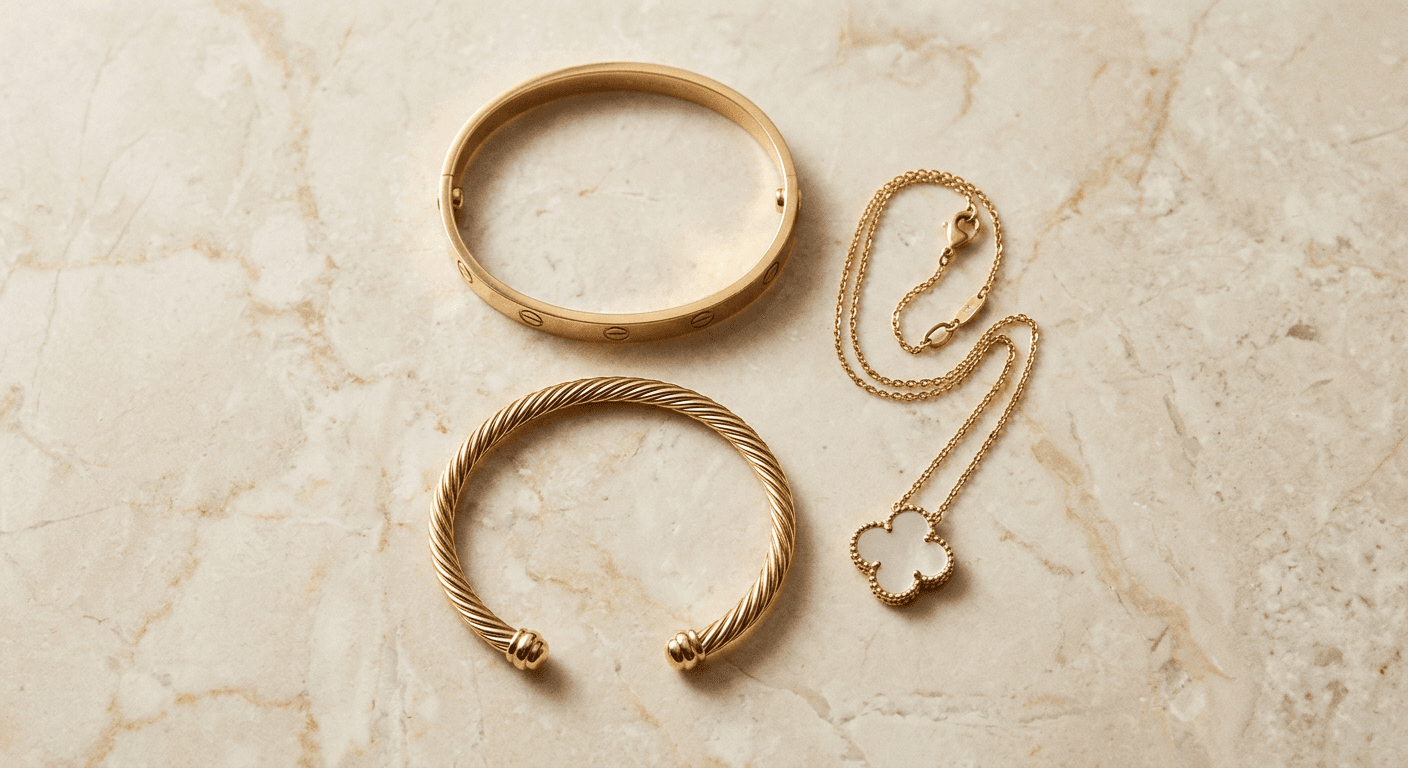
A designer jewelry dupe is a lower-cost piece that borrows the look of a well-known design. People use the word for two different things. One is a piece sold under its maker's own name that resembles a famous design. The other is a copy that carries the designer's name or logo, which is a counterfeit: US trademark law defines a counterfeit as "a spurious mark which is identical with, or substantially indistinguishable from, a registered mark" (15 U.S.C. 1127, checked 16 November 2026). This page covers only the first kind and links to nothing sold as a replica.
We have not bought, worn or handled any piece on this page, so nothing here describes how a dupe looks or lasts. What follows is what the designer originals cost on pages we read, with the date; what US labelling rules say "vermeil", "gold filled" and "sterling" have to mean; and what the brands have done in court about look-alikes. We are not lawyers and this is not legal advice.
Key takeaways
- •Cartier's US site listed the LOVE bracelet, classic model, in 18K yellow gold at $7,950 on 16 November 2026. PurseBop's price table shows it was $7,350 until 25 September 2025.
- •David Yurman's US site listed two 5mm sterling silver Classic Cable bracelets at $750 and $795 on 16 November 2026.
- •Under US FTC guidance, 'vermeil' means sterling silver under at least 2.5 microns of gold, while 'gold electroplate' can be as thin as 0.175 microns. The sections we read do not mention 'PVD' coatings or stainless steel.
- •Leaving the logo off does not settle the legal question for sellers. Cartier, Van Cleef & Arpels and David Yurman have each gone to court over look-alike designs, and the reports are linked below.
Four designer pieces and what the originals cost
1. The Love Bracelet (Cartier)
Cartier's US site lists the LOVE bracelet, classic model (Ref. B6067517) at $7,950. The page describes it as 18K yellow gold (750/1000), 6.1mm wide, with a "fastening system: two functional screws", and says it "comes with a screwdriver" (checked 16 November 2026). That price dates from last autumn: PurseBop's table of Cartier's second US increase of 2025 (published 5 September 2025, updated 25 September 2025, checked 16 November 2026) shows the classic model in 18K yellow gold going from $7,350 to $7,950, a rise of 8.1%, and the small model from $4,950 to $5,300.
There is a visible second-hand market. The 1916 Company, a pre-owned dealer, listed 320 pre-owned Cartier bracelets when we checked on 16 November 2026. On the first page, shown to us in pounds, Love bracelets started at £3,700 for the small model.
Cartier goes to court over copies, and not only over pieces stamped with its name. In June 2022 Amazon and Cartier filed two suits in federal court in Washington state against sellers and an influencer. According to The Fashion Law's report (15 June 2022, checked 16 November 2026), the listings showed "seemingly non-infringing, non-branded products", while the complaint alleged that what was shipped bore Cartier trademarks. In July 2025 Cartier's owner, Richemont, sued a New York jeweler, Malidani Jewelry Corp., over pieces resembling the LOVE bracelet and other designs, with LOVE-style bracelets priced at $2,800. The Fashion Law reports (6 August 2025, updated 7 July 2026, checked 16 November 2026) that the case ended in a consent judgment on 7 July 2026, with a permanent injunction and a $205,000 payment. In France, a Paris court ruled for Cartier in March 2025 (The Fashion Law, 6 March 2025, checked 16 November 2026) against a London company that sold bracelets under the name "GOUSSIN LOVE", awarding €10,950, €8,000 and €5,000 under three heads of damages.
2. The Clover Necklace (Van Cleef & Arpels)
Our Van Cleef dupe guide has the detail, and the figures here are taken from it. A Vintage Alhambra pendant in 18k yellow gold and mother-of-pearl was $3,100 in the US after the 25 April 2025 price rise, according to PurseBop's price table (updated 25 April 2025, checked 16 November 2026). That is an April 2025 figure, not today's price.
That guide lists four 14k gold clover pieces from Macy's, REEDS Jewelers and Bloomingdale's whose listings were read on the retailers' own pages on 16 November 2026. They were priced that day from $429 to $2,062.50, and both ends of that range were sale prices (list prices $1,700 and $5,500). They are listed there by price, not ranked.
The clover shape itself is contested. Richemont, which owns Van Cleef & Arpels, filed a complaint against a New Jersey seller, Silversmiths Inc., on 12 February 2025 over necklaces priced from $40 to $700, and claims rights in the four-lobed design, not only the name, according to The Fashion Law's report of the complaint (19 February 2025, checked 16 November 2026). Those are allegations, not findings.
3. The Twisted Cable (David Yurman)
David Yurman's US site lists the Renaissance Classic Cable Bracelet in sterling silver, 5mm at $750 and the Classic Cable Bracelet in sterling silver with 14K yellow gold domes, 5mm at $795 (both checked 16 November 2026). The second page says Cable "began as a bracelet that he hand-twisted from 50 feet of wire". These are two examples, not the lowest or highest price in the line.
The legal position is argued from both sides. David Yurman sued the gold supplier Royal Chain in New York in September 2023, asserting a registered trademark for its twisted cable bracelet design along with trade dress and copyright claims; Royal Chain called the claims baseless, according to The Fashion Law (20 September 2023, checked 16 November 2026), which reports no outcome. When the brand sued Mejuri in December 2021, Mejuri answered that twisted designs go back to Ancient Rome and that "given the commonplace nature of the twist motif, Yurman cannot legitimately claim" the design, as National Jeweler reported (9 March 2022, checked 16 November 2026). The same report notes that David Yurman holds federal trademark registrations for its specific cable bracelet design.
A silver alternative should at least be what it says it is. Under the FTC's Jewelry Guides, "sterling silver" and "sterling" may be used only for metal that is "at least 925/1,000ths pure silver" (16 CFR 23.5, checked 16 November 2026).
4. The T-Wire (Tiffany)
Tiffany's US site listed the Tiffany T "Narrow Wire Bracelet in Yellow Gold" at $2,500 and the "Wire Bracelet in Yellow Gold" at $3,950 on its T by Tiffany collection page (checked 17 November 2026). The second-hand market gives another reference: The 1916 Company's pre-owned Tiffany & Co. bracelets page showed 11 bracelets on 16 November 2026, four of them titled "Tiffany T Wire Cuff Bracelet" at £1,500, £3,250, £3,800 and £7,550. The listing page does not state the metal of each, so the four are not like for like.
Other Notable Mentions
Bulgari "Serpenti" (The Snake)
Collector Square, a European marketplace for pre-owned luxury goods, showed 11 Bulgari Serpenti pieces on 16 November 2026. Among the first ten, seven Serpenti Viper rings in pink, rose or white gold with diamonds ran from €2,650 to €12,500, and three Serpenti Viper bracelets in gold and diamonds were €49,800, €49,800 and €69,800. These are a dealer's asking prices in euros for used pieces, not Bulgari's US prices, but they show the material a look-alike is being compared with: gold set with diamonds.
Hermes "H" Bracelet (Clic H)
A pre-owned pair offered by Sotheby's (checked 16 November 2026) is described as "Vert Olive Enamel Clic H Bracelet PM Palladium Hardware" and "White Enamel Clic H Bracelet PM Palladium Hardware", each 1.2 cm wide for a 17 cm wrist, sold with dust pouches and boxes. The page showed no price when we read it. The listing describes enamel and palladium hardware, not gold, so the gold rows of the material table below do not describe this original.
Chanel "CC" Earrings
There is no dupe to list here, because the design is the logo. Earrings carrying interlocking Cs that Chanel did not make are what the definition of a counterfeit quoted at the top of this page describes. Chanel has gone further than that: in February 2021 it sued an Atlanta jewelry business, Shiver + Duke, in New York over jewelry made from what were said to be authentic Chanel buttons bearing its interlocking C logo. The Fashion Law reported (18 November 2022, updated 30 November 2022, checked 16 November 2026) that the parties reached a settlement in principle on 14 November 2022 and that the logo-bearing jewelry was removed from the seller's website.
An earlier version of this page pointed readers to DHgate for these earrings. We have withdrawn that. The US Trade Representative's 2025 Review of Notorious Markets for Counterfeiting and Piracy (released 3 March 2026, checked 16 November 2026) includes DHgate and says "some stakeholders continue to observe that DHgate remains a significant source of counterfeits that remain easily accessible through search results". The review also records DHgate's account of its screening and vendor checks, and USTR's release says the list does not reflect findings of legal violations.
Material guide: what the labels mean
We cannot rank materials from experience. What can be compared is what each label is required to mean. The US Federal Trade Commission's Jewelry Guides set that out (16 CFR 23.3 for gold, 23.4 for vermeil and 23.5 for silver, all checked 16 November 2026):
| Label on the listing | What the FTC Jewelry Guides say it means | What is under the surface |
|---|---|---|
| Solid Gold (14k) | The karat mark states the fineness of the alloy, with fine gold counted as 24 karat: 14 parts in 24, or 58.3% gold | Nothing. The alloy runs through the piece |
| Gold Vermeil | Gold of at least 10 karat, at least 2.5 microns thick, on all significant surfaces | Sterling silver |
| Gold Filled | A plating of gold alloy that makes up at least 1/20th of the weight of the metal in the article | Base metal |
| Heavy gold electroplate | At least 2.5 microns of fine gold, or the equivalent | Base metal |
| Gold electroplate | At least 0.175 microns of fine gold, or the equivalent | Base metal |
| Sterling silver | At least 925/1,000ths pure silver | Nothing. The alloy runs through the piece |
| Stainless Steel (PVD) | Not named. Neither the gold section nor the vermeil section mentions stainless steel or PVD | Steel. Ask whether the coating contains gold and how thick it is |
| Brass / Alloy | Not a gold or silver term. Ask which of the plating rows above, if any, the seller claims for it | Base metal. Ask which metals, and whether it contains nickel |
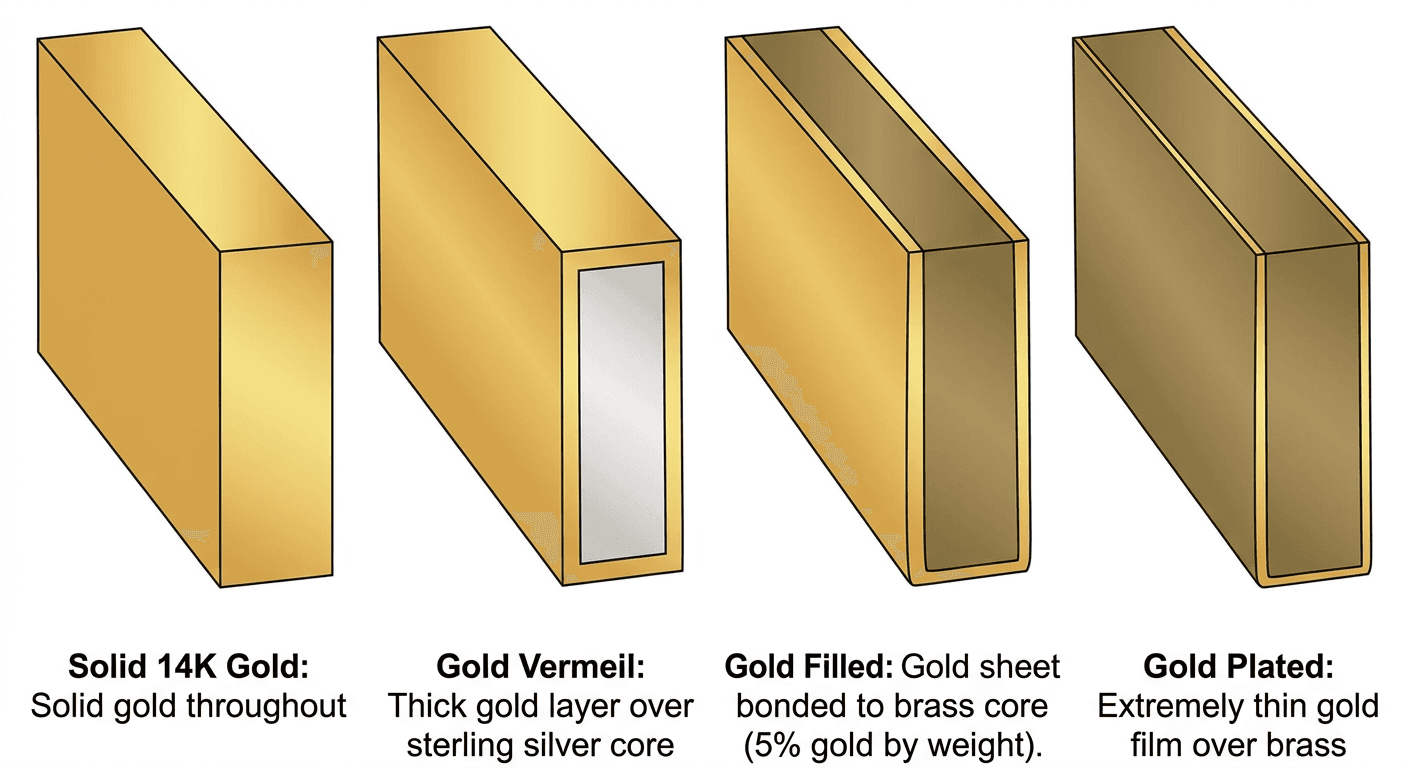
The gap between the two electroplate rows is large: the floor for "vermeil" and "heavy gold electroplate" is about 14 times the floor for plain "gold electroplate". The Guides also say a piece should not be called gold plated unless the plating is of "reasonable durability", which a footnote explains as "all areas of the plating are sufficiently thick to assure coverage that reasonable consumers would expect". They do not require the thickness to be printed on the listing, so a seller who writes only "gold plated" has told you very little.
On skin reactions, the one thing we can source is nickel. The American Academy of Dermatology says "it's common for a nickel allergy to develop from wearing jewelry containing nickel" and advises wearing jewelry that is "nickel-free, hypoallergenic, or made from metals such as surgical-grade stainless steel", and it also names "18-, 22-, or 24-karat yellow gold, pure sterling silver, or platinum" (AAD, nickel allergy, checked 16 November 2026). If you react to nickel, ask the seller what the base metal is before buying anything plated.
What to check before you buy
Use this list on any listing described as "inspired by" a designer piece:
- The piece is sold under the seller's own name, with no designer name, logo, serial number or branded box in the photos.
- The listing does not use the words "replica", "1:1" or "mirror".
- The metal is named with a term from the table above. "Premium alloy" is not one.
- For anything plated, the thickness in microns and the metal underneath are stated, or the seller gives them when asked.
- The return window is stated in days, in writing.
The summary is short. On the brands' own pages we read, the originals cost $750 and $795 for two silver David Yurman cable bracelets and $7,950 for a gold Cartier LOVE bracelet. The four clover pieces in our Van Cleef dupe guide, priced from $429 to $2,062.50 on the day they were read, are the only alternatives whose listings we have read and dated. For everything else, the label rules and the checklist above are what this page can offer.
Correction, 16 November 2026: An earlier version of this guide was titled "Best Designer Jewelry Dupes 2026: The Ultimate List" but named almost no product and was not based on any test. It gave the Cartier Love bracelet as $7,900; Cartier's US site lists the classic model in 18K yellow gold at $7,950. It gave David Yurman's cable bracelet as "$600+"; the two 5mm bracelets we read on the brand's site are $750 and $795. It gave a Tiffany T wire bracelet as $2,500 and a Van Cleef clover necklace as "$3,000+" with no source or date; the Tiffany figure is now dated and sourced to Tiffany's US site, where it is the price of the narrow wire bracelet in yellow gold, and the Van Cleef figure has been replaced with a dated one. It said designer brands "charge a 1000% premium", that steel "won't scratch", that PVD plating "lasts for years", that vermeil "lasts 2-5 years", that steel's gold color "lasts 3-5 years" and that brass "turns skin green in 2 days"; none had a source and all have been removed, along with dupe prices of $20, $25, $60 and about $80 and a claimed saving of $8,500. It directed readers to DHgate for copies of Chanel logo earrings and said buying a fake was "almost mechanically identical to the real thing"; that has been withdrawn, and the page no longer points to any source of counterfeit goods. It described logo copies as a "copyright" matter; the relevant law is trademark.
Published by David Adams, founder of TheCaratCut. Most guides were first drafted with AI tools and are being re-checked against their sources, with AI help; every correction is approved by David before it goes live. Our recommendations follow our editorial policy. We may earn commissions through affiliate links — see our disclosure.